The Role and Importance of This Formula in International Oil Trade
EN 590 10 ppm diesel is a low-sulfur diesel fuel widely used in markets that demand high environmental standards, particularly across Europe. In international oil trade, the…

EN 590 10 ppm diesel is a low-sulfur diesel fuel widely used in markets that demand high environmental standards, particularly across Europe. In international oil trade, the pricing of this product is typically based on industry benchmarks to ensure transparency and alignment with market conditions. The formula used here is not just a calculation mechanism but a critical foundation for trust and operational efficiency between buyers and sellers.
The use of the PLATTS FOB MED (AAWYY00) index as the base price ensures that transactions reflect up-to-date market conditions. This index, published daily, is widely accepted in the Mediterranean oil markets and serves as a neutral and authoritative pricing source. By tying the price to this benchmark, both parties reduce the risk of disputes and maintain a fair valuation framework.
The Disc (discount) element of the formula represents the commercial flexibility in negotiations. Whether it's gross or net discount, this figure often accounts for logistical, insurance, and other operational costs. It gives sellers room to offer competitive rates while still covering their margins and obligations. On the buyer’s side, the discount reflects real-world trading terms rather than abstract or fixed prices.
Including density (Dens) in the formula brings a significant quality consideration into the pricing. Density directly affects the energy content and combustion efficiency of diesel. Therefore, adjusting the price according to the actual measured density ensures that the buyer pays for the true value of the product being delivered. The reference value of 845 kg/m³ is based on the EN 590 quality standard; any deviation is factored in fairly through this formula.
This pricing method becomes even more relevant under CIF (Cost, Insurance, Freight) terms. Under CIF contracts, the seller is responsible for delivering the goods, covering freight costs and marine insurance. Consequently, a detailed formula accounting for density and discount ensures full cost visibility. When the delivery port is specified—such as Mersin in this case—pricing becomes more predictable, helping both sides plan their logistics and finances effectively.
Another key advantage of this structure is the reduction of contractual risk. When both parties refer to the same index (PLATTS) and apply the same calculation method, the likelihood of pricing disputes is greatly reduced. In high-volume petroleum transactions, where even small price variances can lead to major financial consequences, this kind of standardized formula promotes stability and trust.
Furthermore, this formula allows importers to accurately forecast their landed costs. With known discount terms and density ranges, the buyer can calculate the CIF price in advance and determine the viability of resale prices in their local markets. This supports strategic planning and enhances the ability to respond to changing market conditions without delays.
In summary, this pricing formula is not just a mathematical model—it is a cornerstone of professional and sustainable international oil trading. It fosters transparency, reduces uncertainty, and ensures that pricing reflects real quality and market conditions. For both buyers and sellers operating in complex, high-stakes markets, such a formula is essential for maintaining competitive advantage and operational confidence.
Pricing Formula for EN 590 10 ppm Diesel
Based on the given example, the pricing formula for EN 590 10 ppm diesel fuel is structured as follows:
Pricing Formula:
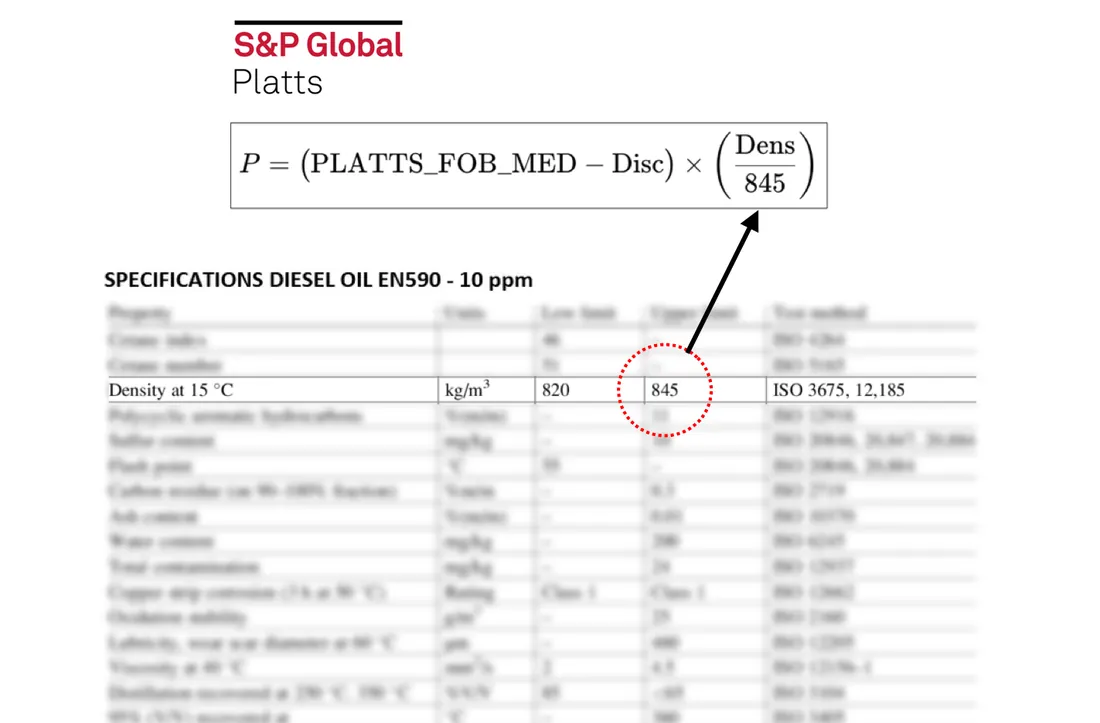
Definitions: P = Final price of the goods in US Dollars per metric ton, rounded to three decimal places. Dens = Actual density of the product at 15°C (kg/m³), as stated in the quality certificate issued during loading, rounded to three decimal places. 845 = Reference density value according to EN 590 standard (kg/m³). Disc = Discount applied to the PLATTS FOB MED (code: AAWYY00) reference price, typically Gross 30 USD / Net 25 USD per metric ton.